
Carolingian Ecclesiastical Republic
Carolingia brings faith, wealth, missionaries, and resurrected martyrs to the Isles. Its theology now collides directly with Kahu’s fire.
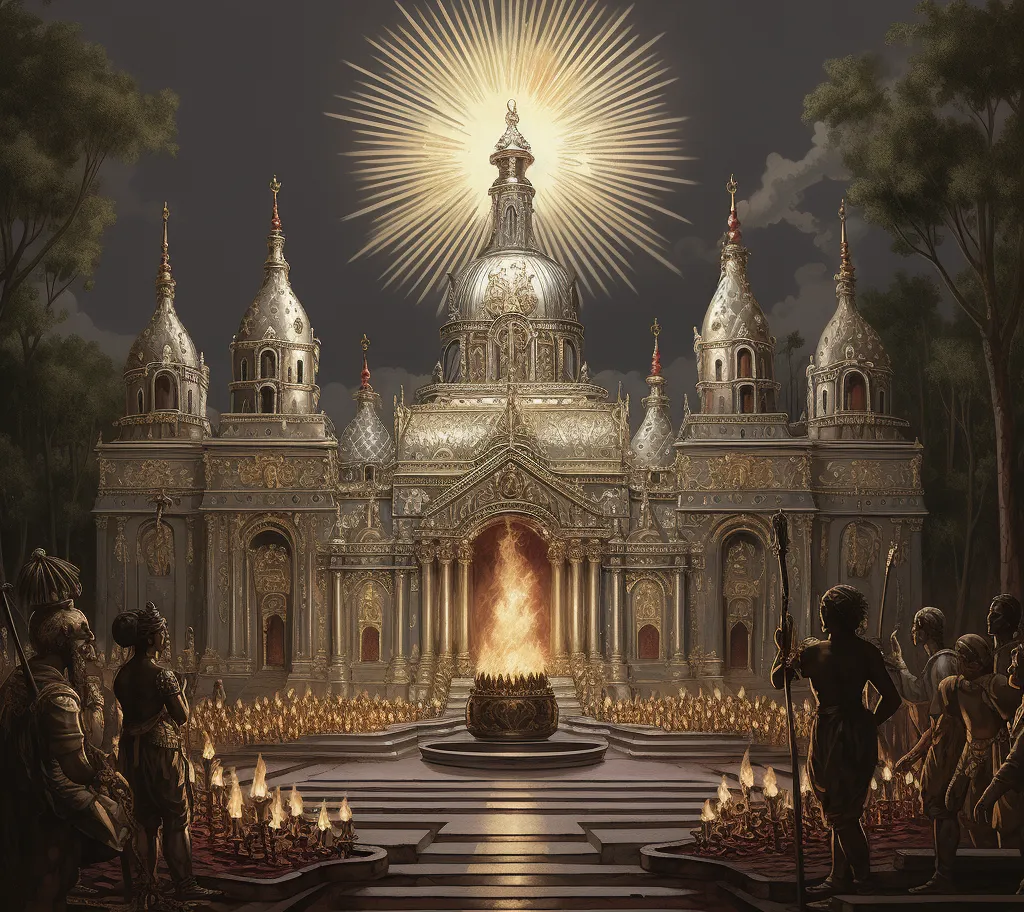
Heartland of the Eternal Flame, Carolingia sends forth as many fervent missionaries to Moa Toa as it does merchants. On top of that, their seemingly unending stockpile of precious metals is used to fuel their equally unquenchable lust for wares from the East. Their membership in the Trade Consortium is represented by the BEC (la Banque d’Est Céleste).
Chief exports: religion, silver, gold
Carolingia is a nation defined by its faith. More than a mere state, it is the temporal domain of the Church of the Eternal Flame, a sprawling theocracy whose influence extends far beyond its own borders. Its capital, the magnificent city of Caput Mundi, is not just a political center but the holiest site for all followers of the Flame, a destination for pilgrims from every corner of the western world.
The Curia of Cardinals
Section titled “The Curia of Cardinals”The ultimate authority in the Republic is the Curia of Cardinals, a council composed of the most senior clergy of the Church. These cardinals, acting as both princes and priests, govern the spiritual and secular affairs of the nation from the grand basilicas of Caput Mundi. They legislate on everything from trade policy to religious doctrine, their decrees carrying the weight of divine law. While Carolingia’s mainland is vast, larger even than Albion and Varangia combined, its recent unification meant it was unable to acquire as much colonial territory as the other western powers. This, combined with a strong zeal to spread the faith, have recently led to some more aggressive and callous acts of expansion that have somewhat soured its reputation in international diplomacy.
The Living Saints
Section titled “The Living Saints”A unique and potent feature of Carolingian faith is the existence of Living Saints. These are individuals who, having died in martyrdom for the Church, were brought back by the divine power of the Eternal Flame. A Living Saint is the embodiment of that power, a revered symbol who intercedes on behalf of the faithful. Though they possess a mortal shell, their essence is eternal; should they be slain again, they will resurrect at the site of their personal reliquary. These sacred objects are secured within the deepest vaults of major basilicas across the land, making each church a fortress and a potential site of divine rebirth. The majority of all known saints reside within Carolingia, granting the Republic an unmatched spiritual authority.
Saints are commonly associated with particular aspects, reflective of their personal qualities or the reason for their martyrdom. Despite being revered as living miracles, they tend not to take on political power or managerial duties, as that is considered not to be their function in the world. As the saying goes, neither bishop nor saint can command the other. An exception to this is when the saint is also the patron of their own holy order, over which they have full authority, and some holy orders can be very influential, both today and even moreso during the Schisms.
The Universal Church
Section titled “The Universal Church”Carolingia as a singular political entity is a relatively recent phenomenon. In centuries past, Carolingia was a fractured land, divided into many states that fought both mundane wars but also holy wars over the true interpretation of scripture. These long and bloody religious wars, known in retrospect as the Great Schisms, ended only a century ago. From its ashes rose the Universal Church, the current iteration of the faith that finally united Carolingia. Today, the Universal Church not only controls the Republic but also holds nominal sovereignty in religious affairs over the churches in both Albion and Varangia, ensuring Carolingian influence is felt, if not always welcomed, across the West.
Whilst Carolingians always placed their greatest stock in their army, in this day and age they could not help but invest into the navy also. Unfortunately, having the weakest naval traditions of the western powers, they have neither a mercantile fleet to leverage, nor the ability to directly contend with Albion ships in size and firepower.
This has led to the development of the so-called Jeune École philosophy, and correspondingly the invention of the Carolingian Xebec. Xebecs intentionally emulate Carolingian trading ships in profile, but are designed for extra speed and maneuverability with auxiliary sails. They may also carry an array of other features such as reinforced bows, hidden guns, fire boats, and even prototype torpedoes that are copied from the East. All these are designed to allow Xebecs to ambush and take down larger warships, but recently the alliance of the Trade Consortium has prevented Jeune École and the Xebec from being truly put to the test against a peer rival power.
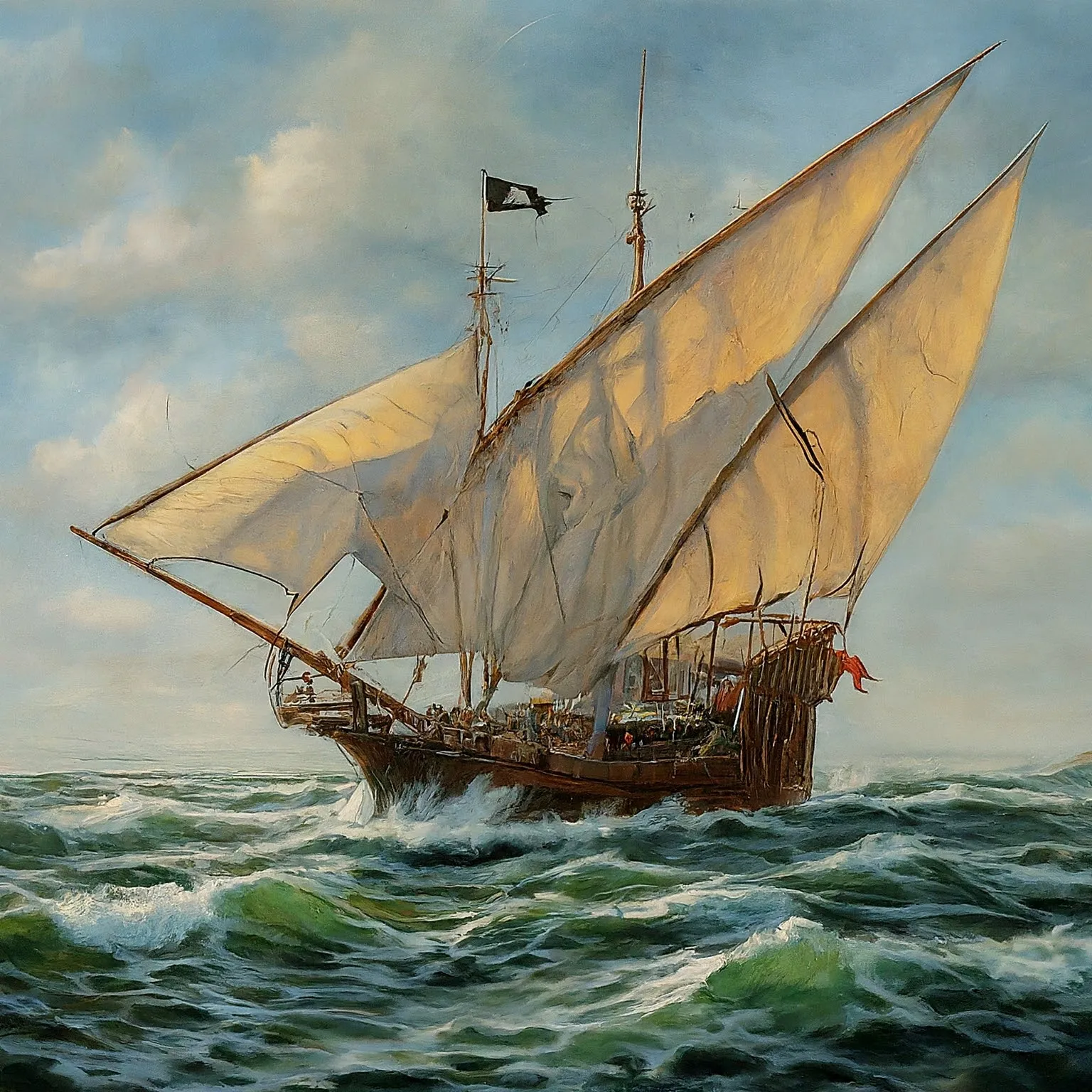
Carolingian Xebec
Of course as a formal navy, the republic employs its own frigates and ships of the line, but in drastically diminished quantity and quality as compared to Albion. For example, Carolingian ships of the line are frequently “shaved” (razée), reducing the number of decks to save costs and again improve maneuverability, at the expense of firepower.
In the chronicle
Section titled “In the chronicle”- Day 33 — A man with a plan and a modelThe crew founds the Fires of Moa, recruits its first followers, and budgets an audacious ironclad heist.
- Day 31 — Liar’s diceLiar’s dice, a revolutionary cave, and the theft of an everlasting fire from Pirate’s Cove.
- Day 30 — DunmeshiThe crew stalks and kidnaps the Mink, uncovering the revolutionary network behind Pirate’s Cove.
- Day 28 — Light treasonDisavowed by Moa Tor, the crew becomes Albian privateers and accepts Prince Pako’s mission to recover a sacred relic.
- Day 27 — Time to poke the Master BaitersAfter helping capture the ironclad, the crew studies its fire-driven engine and dines with Saint Sebastian.
- Day 26 — My sailorThe Lively Lady serves as bait in a multinational trap for a Cathayan ironclad—and ends up inside the assault.
Show 10 earlier chapters
- Day 25 — The calm after the stormThe rescued migrants return to their fleet, where a celebration becomes the prelude to an international naval operation.
- Day 20 — This girl is on fireA burning amnesiac awakens as Kahu while Carolingia prepares to send three Living Saints into the Isles.
- Day 18 — BBQA blood-boar victory feast brings grief, trade, Punx’s departure, and urgent news from Oro.
- Day 15 — Diplomatic incidentThe investigation into Saint Sebastian’s death collides with local politics as the boggarts bring catastrophic news.
- Day 14 — Who dunnit?A voyage with the Contessa and Saint Sebastian becomes a murder mystery with dangerous religious implications.
- Day 13 — Amuse boucheThe Migrant Fleet arrives with tales of slavery and the crew receives new diplomatic and rescue missions.
- Day 12 — Day at the zooAlbion’s opera-house envoy introduces the crew to Living Saint Sebastian and his hunt for Don Gregorio.
- Day 11 — Master & CommanderPirates, a storm-damaged ship, and a tense return to Kapikala expand the crew’s view of the foreign powers.
- Day 4 — The Doom of the BunyipsAfter surviving the bunyips, the expedition reaches Bloombark and meets Queen Killipella and Don Gregorio.
- Day 3 — Voyage to the Elephant IslesCompeting foreign interests converge as the party sails to the Elephant Isles and narrowly survives its first landing.